

CASE STUDY · WIDE NOSE RHINOPLASTY
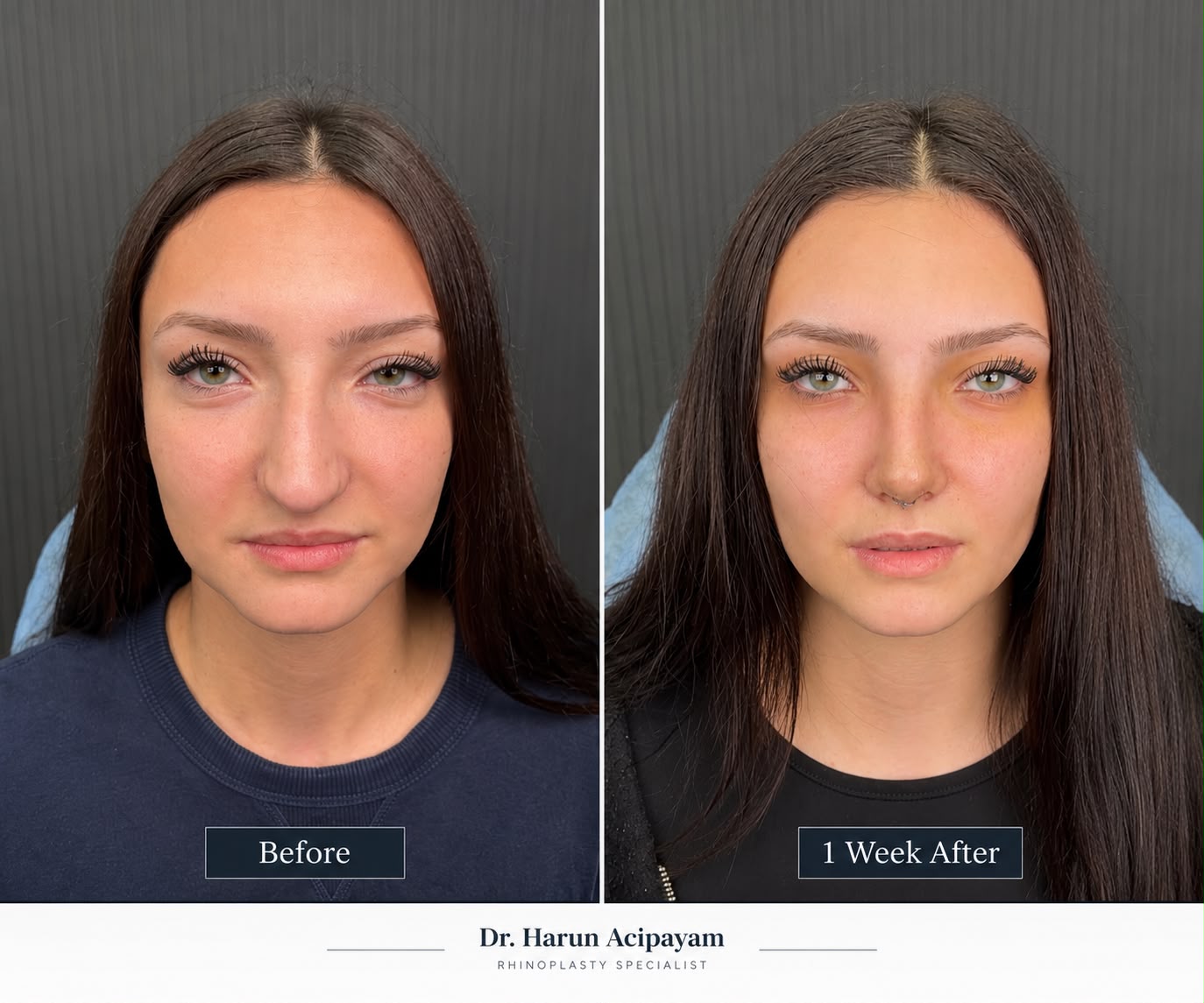
Wide Nose Rhinoplasty at Age 19: Before & After Case Study
Five concerns, thick skin and a breathing problem, treated in one operation by Op. Dr. Harun Acıpayam, ENT surgeon in Antalya.
Get a Free QuoteCASE AT A GLANCE
- AGE
- 19
- CONCERNS
- Wide nose · bulbous tip · droopy tip · crooked nose · breathing problem
- SKIN
- Thick skin
- PROCEDURE
- Septorhinoplasty: shape and breathing in one operation
Can a wide, crooked nose with a bulbous, drooping tip be corrected when the skin is thick? Yes, and in one operation. In this case a 19-year-old patient had the bridge narrowed and straightened, the tip refined and lifted, and the breathing problem treated in the same surgery. Because thick skin hides fine detail, the result was built on structural support under the skin rather than on removing cartilage.
Five Concerns in One Nose
This 19-year-old patient came to Dr. Harun Acıpayam with a list rather than a single complaint: the nose looked wide from the front, the tip was round and dropped downward, the bridge was not straight, and breathing through the nose was difficult.
Each of these is a common reason for rhinoplasty. What made this case demanding was having all of them together, under thick skin. Thick skin does not shrink around a smaller framework the way thin skin does, so the usual approach of simply reducing the nose would have left the tip round and undefined.
Age was not a limitation. By 19 the nose has finished growing, so the result can be planned on a stable facial structure.
What the Consultation Showed
Five concerns and one skin type shaped the surgical plan.
Wide nose
From the front, the bridge and the base of the nose took up too much of the mid-face.
Why it mattered: width is the first thing seen in the frontal view, and narrowing has to stay in proportion with the eyes and cheeks.
Bulbous tip
The tip was round and full, without clear definition points.
Why it mattered: a bulbous tip makes the whole nose look larger, even when the bridge is narrowed.
Droopy tip
The tip pointed downward instead of sitting level with the profile line.
Why it mattered: a drooping tip lengthens the nose and usually signals weak tip support.
Crooked nose
The bridge did not follow the midline of the face.
Why it mattered: a nose that is crooked on the outside is often deviated on the inside too.
Breathing problem
The patient had difficulty breathing through the nose.
Why it mattered: narrowing a nose without treating the airway can make breathing worse, not better.
Thick skin
The skin over the tip was thick, which softens the outline of the cartilage underneath.
Why it mattered: thick skin rhinoplasty needs a stronger framework and a longer healing period.
Planning for Thick Skin
With this many concerns, the order and the method matter as much as the goals. These three questions shaped the plan.
Structure under thick skin
Thick skin will not drape tightly over a reduced tip. Definition was planned by reshaping and reinforcing the tip cartilages so their outline shows through the skin.
Shape and breathing together
The crooked bridge and the airway are part of the same structure. Treating them in one operation means one anaesthetic and one recovery.
Narrower, still in proportion
An over-narrowed nose looks pinched and can restrict airflow. The width was planned against the patient’s eyes, cheeks and lips, not against a reference photo.
How the Surgery Was Done
- 01Airway and septumThe inside of the nose was corrected first, so the airway is open and the nose has a straight central support
- 02Straightening the bridgeThe nasal bones were repositioned to bring the bridge back toward the midline. See piezo vs traditional bone shaping
- 03NarrowingThe bridge was brought in for slimmer lines from the front
- 04Tip refinementThe tip cartilages were reshaped to turn a round, bulbous tip into a smaller and more defined one
- 05Tip lift and supportThe drooping tip was rotated upward and supported so that it holds its position under thick skin
As an ENT surgeon, Dr. Acıpayam treats the shape of the nose and the airway in the same operation. Read more about solving rhinoplasty and breathing problems at the same time.
Recovery With Thick Skin
Thick skin holds swelling longer than thin skin, so the timeline is slower, especially at the tip.
The cast comes off. The nose is already narrower and straighter, but still swollen. Cast removal day.
The bridge settles first and the frontal view starts to look slimmer.
Tip swelling goes down gradually and the new tip position becomes clear.
Final tip definition. With thick skin, this last stage takes the longest.
Our recovery guide covers each stage in detail.
What Changed
Each of the patient’s concerns maps to one visible or functional change.
- 01Wide noseA slimmer bridge and a narrower frontal view, in proportion with the face
- 02Bulbous tipA smaller, more defined tip, within what thick skin allows
- 03Droopy tipThe tip is lifted and supported instead of pointing downward
- 04Crooked noseThe bridge sits closer to the midline of the face
- 05Breathing problemThe airway was treated in the same operation as the shape
With thick skin, the tip continues to refine for a year or more after surgery. Compare the shape of the nose rather than overall appearance.
What This Case Shows
- 1
Thick skin changes the method, not the goal
A bulbous tip under thick skin is refined by building structure, not by removing as much cartilage as possible.
- 2
Shape and breathing belong in one plan
A crooked nose and a breathing problem usually share a cause, and both can be treated in a single operation.
- 3
A lifted tip needs support to stay lifted
Without structural support, a droopy tip tends to drop again as swelling settles. See rotation and projection loss.
Common Questions
Can rhinoplasty make a wide nose narrower?
Yes. A wide nose is narrowed by bringing the nasal bones closer together and, where needed, refining the tip. How much narrowing suits a face depends on the eyes, the cheekbones and the skin thickness, so the amount is set individually at consultation.
Can a bulbous tip be refined if the skin is thick?
Yes, but the approach changes. Thick skin hides fine detail, so the tip cartilages are reshaped and reinforced to create definition that shows through the skin. Removing cartilage alone tends to leave a thick-skinned tip round and unsupported.
Can a crooked nose and a breathing problem be fixed in one surgery?
In most cases, yes. A nose that is crooked on the outside often has a deviated septum inside. Septorhinoplasty straightens the septum and reshapes the nose in a single operation, with one anaesthetic and one recovery period.
Is 19 old enough for rhinoplasty?
Yes. The nose usually finishes growing in the mid to late teens, so by 19 the facial structure is mature. What matters as much as age is that the decision is the patient’s own and that expectations are realistic.
What causes a droopy nose tip, and can it be lifted?
A droopy tip usually comes from weak support in the tip cartilages, and it often drops further when smiling. In rhinoplasty the tip is rotated upward and then supported structurally so that it holds its new position as healing progresses.
How long does swelling last after rhinoplasty with thick skin?
Longer than with thin skin. Most swelling fades within the first few months, but a thick-skinned tip keeps refining for 12 to 18 months, sometimes longer. The shape seen at cast removal is not the final result.
YOUR CONSULTATION
Wide Nose, Bulbous Tip or Thick Skin?
A personal assessment shows how much narrowing, tip refinement and lift your nose and skin type can carry, and whether your breathing can be treated in the same operation. Learn more about rhinoplasty in Turkey or browse the before and after gallery.
Get a Free Quote on WhatsAppIndividual results vary. Before-and-after images show the outcome of a specific patient and are not a guarantee of results.