

A well-defined nose is not simply a smaller nose. In rhinoplasty, definition comes from the relationship between the nasal tip, bridge, width, symmetry and overall facial proportions.
Some patients may have several anatomical features at the same time, such as a boxy nasal tip, dorsal hump, wide nose or crooked nose. In these cases, focusing on only one area may not create a balanced result. Instead, rhinoplasty planning may involve refining different parts of the nose together to create a smoother and more harmonious nasal contour.
The patient shown in this before-and-after example presented with a combination of these characteristics. The surgical plan focused on improving the definition of the nasal tip and bridge, reducing excessive width and creating a straighter, more balanced appearance from the front.
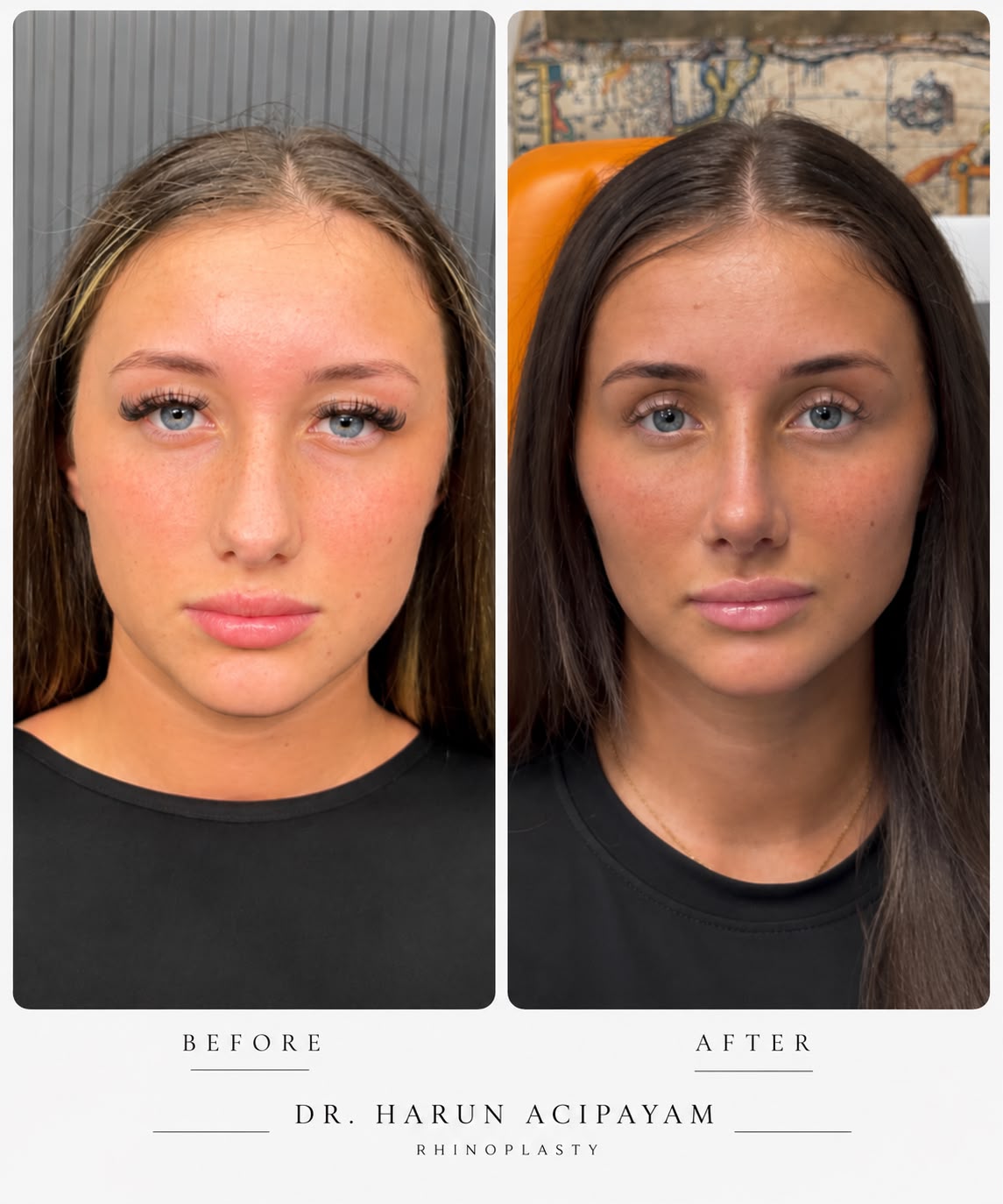
CASE STUDY
One Nose, Four Concerns, One Plan
This patient presented with a combination of features. Rather than correcting one area in isolation, the tip, bridge, width and alignment were planned together.
- 01Boxy tipTip contours refined for clearer, natural definition
- 02Dorsal humpBridge smoothed for a continuous line toward the tip
- 03Wide noseProportional narrowing with breathing in mind
- 04Crooked noseBridge and tip brought into better alignment
- More defined tip
- Narrower, straighter bridge
- Improved symmetry
Concerns noted by Dr. Harun Acıpayam. Frontal view of an individual result; outcomes vary.
What Is Nasal Definition in Rhinoplasty?
Nasal definition describes how clearly the different anatomical lines and contours of the nose can be seen.
A well-defined nose usually has:
- A nasal tip with clear but natural contours.
- A smoother transition between the nasal bridge and tip.
- Balanced nasal width when viewed from the front.
- Better symmetry between the right and left sides.
- Proportions that complement the rest of the face.
Definition does not necessarily mean creating an extremely narrow or sharply sculpted nose. The objective is generally to achieve clearer contours while maintaining a natural appearance.
For this reason, rhinoplasty planning should consider the nose as a three-dimensional structure rather than treating the tip, bridge or nostrils as completely separate areas.
Refining a Boxy Nasal Tip
A boxy tip can make the lower part of the nose appear broad, square or insufficiently defined.
This appearance is often related to the shape, size and position of the lower lateral cartilages that form the nasal tip.
During nasal tip refinement, the surgeon may reshape or reposition these cartilages to create more distinct tip contours.
Depending on the anatomy, tip refinement may involve:
- Reshaping the tip cartilages.
- Adjusting the distance between the tip-defining points.
- Improving tip symmetry.
- Controlling nasal tip projection.
- Adjusting tip rotation where necessary.
- Supporting the cartilage structure to maintain long-term stability.
The objective is not simply to make the tip smaller. Instead, the aim is to create a better-defined tip that remains proportional to the nasal bridge and the rest of the face.
Dorsal Hump Reduction and Nasal Bridge Contouring
A dorsal hump is a prominent area along the nasal bridge that is particularly noticeable from the side profile.
However, reducing a hump involves more than removing the visible prominence.
The surgeon must also consider how the new bridge height will relate to:
- The nasal tip.
- The forehead.
- The lips and chin.
- Overall facial profile.
- The width of the nasal bones.
After dorsal hump correction, the nasal bridge may require additional contouring to create a smooth transition from the radix — the upper starting point of the nose — toward the tip.
Dr. Harun Acıpayam’s rhinoplasty approach includes assessment of both the nasal dorsum and tip as part of overall facial balance. His Antalya practice describes rhinoplasty planning as combining facial analysis with structural and functional assessment. Op. Dr. Harun Acıpayam
Narrowing a Wide Nose
A nose that appears wide from the front may be influenced by several structures.
These can include:
- The width of the nasal bones.
- The middle third of the nose.
- The shape of the nasal tip.
- The width of the nostril base.
Because of this, wide nose rhinoplasty should first identify where the excess width originates.
In some patients, narrowing the bony nasal framework may improve the upper portion of the nose. In others, tip refinement may have a larger effect on the overall frontal appearance.
The objective is generally proportional narrowing rather than creating the narrowest possible nose.
A nose that is excessively narrowed may look unnatural or, more importantly, compromise structural support and nasal airflow. This is why width reduction should be planned according to the patient’s individual anatomy.
Correcting a Crooked Nose
A crooked nose can create visible asymmetry from the front.
The deviation may involve the nasal bones, cartilage, nasal septum or a combination of these structures.
This makes crooked nose rhinoplasty particularly dependent on detailed anatomical assessment.
Correction may involve:
- Straightening the nasal bones.
- Repositioning cartilage structures.
- Correcting septal deviation where appropriate.
- Reinforcing areas that require additional structural support.
- Improving the alignment between the bridge and nasal tip.
In some cases, external nasal deviation may also be associated with internal structural differences that affect breathing. Because Dr. Harun Acıpayam is an ENT surgeon as well as a rhinoplasty specialist, his published approach includes evaluation of nasal function alongside aesthetic planning. Op. Dr. Harun Acıpayam
Why the Nasal Tip and Bridge Should Be Planned Together
One of the most important principles of rhinoplasty is that changing one structure can affect the visual relationship of another.
For example, lowering a dorsal hump without considering the nasal tip may cause the tip to appear more prominent.
Likewise, narrowing the bridge without refining a broad nasal tip may create an imbalance between the upper and lower thirds of the nose.
For this reason, patients with a combination such as:
boxy tip + dorsal hump + wide nose + nasal deviation
often require a comprehensive rhinoplasty plan rather than a single isolated correction.
The goal is to establish a continuous and balanced nasal contour from the bridge to the tip.
Creating a More Defined Nasal Contour
From the front, a refined nasal contour is influenced by what surgeons often describe as the dorsal aesthetic lines.
These are the visual lines running from the eyebrow region along both sides of the nasal bridge toward the tip.
When the nose is wide, asymmetric or crooked, these lines may appear irregular.
Rhinoplasty can potentially make these contours:
- Straighter.
- More symmetrical.
- More continuous.
- Better proportioned to the face.
At the same time, the nasal tip can be refined so that it transitions naturally from the bridge rather than appearing as a separate or overly rounded structure.
This combined approach is particularly relevant for patients seeking greater nasal definition.
Before and After: What Changes Can Be Evaluated?
Before-and-after rhinoplasty photographs are most useful when individual anatomical changes are considered rather than simply deciding whether one photograph looks “better.”
In a case involving a boxy tip, dorsal hump, nasal width and deviation, useful points of comparison include:
Nasal tip:
Whether the tip contours appear more distinct and balanced.
Nasal bridge:
Whether the dorsal hump has been reduced and the profile appears smoother.
Frontal width:
Whether the nasal framework appears more proportional to the face.
Symmetry:
Whether deviation has been reduced and the nose appears more centred.
Overall contour:
Whether the bridge, middle vault and tip form a more continuous nasal shape.
Before-and-after photographs represent an individual surgical result. They cannot predict exactly how another patient’s nose will respond to surgery because anatomy, skin thickness, cartilage strength and healing patterns differ between individuals.
Natural Rhinoplasty Is About Proportion, Not a Standard Nose
Modern rhinoplasty is increasingly based on preserving individual facial characteristics rather than applying one standard nasal shape to every patient.
A nose may need to be narrower without becoming excessively narrow.
A nasal tip may need greater definition without looking pinched.
A hump may need reduction without producing an unnaturally low nasal bridge.
And a crooked nose may need improved alignment while preserving sufficient structural support.
This is why detailed evaluation before surgery is essential.
The appropriate degree of tip refinement, dorsal reduction or nasal narrowing varies from one person to another.
Rhinoplasty in Antalya with Dr. Harun Acıpayam
Dr. Harun Acıpayam is an ENT Surgeon and Rhinoplasty Specialist based in Antalya, Turkey. His practice focuses on aesthetic and functional rhinoplasty, including assessment of the nasal tip, bridge, septum and overall facial proportions. Op. Dr. Harun Acıpayam
For patients travelling to Antalya for rhinoplasty, the planning process begins with an individual assessment of nasal anatomy and the changes the patient would like to discuss.
Rather than evaluating one feature in isolation, factors such as tip shape, bridge height, nasal width, symmetry, skin characteristics and breathing function can all influence the final surgical plan.
Frequently Asked Questions
Can rhinoplasty make a boxy nose tip more defined?
Rhinoplasty can reshape and reposition the cartilage structures responsible for a broad or boxy nasal tip. The degree of refinement possible depends on cartilage anatomy, skin thickness and structural support.
Can a dorsal hump and wide nose be corrected during the same rhinoplasty?
They can often be addressed during the same operation when clinically appropriate. The bridge, nasal bones and tip are planned together to maintain proportion.
Can rhinoplasty straighten a crooked nose?
Rhinoplasty may improve nasal deviation by addressing bone, cartilage and septal structures. Complete symmetry cannot be guaranteed because facial and nasal anatomy are naturally asymmetric.
What does nasal narrowing involve?
Nasal narrowing may involve modification of the nasal bones, middle vault, tip or nostril base depending on where the width originates.
How long does it take to see nasal definition after rhinoplasty?
Initial changes are visible relatively early, but swelling—particularly around the nasal tip—can obscure fine definition for several months. Final refinement develops gradually as healing progresses.
Considering Rhinoplasty for a Wide, Crooked or Poorly Defined Nose?
If your concerns include a boxy nasal tip, dorsal hump, wide nasal bridge or crooked nose, the most appropriate rhinoplasty plan depends on how these structures interact with one another and with the rest of your face.
A detailed assessment can determine which areas may benefit from refinement while preserving nasal support, facial proportion and breathing function.
Share your preferred WhatsApp contact to discuss your rhinoplasty goals with Dr. Harun Acıpayam’s team.